Updated: Aug 21, 2025

In the first sentence of the Bible, God identifies Himself as creator of heaven and earth. This claim has been hotly contested, especially in the modern era. A serious denial of God's creative nature commenced with Charles Darwin's publication of the Origin of the Species in 1859. Darwin's book was so powerful that it seems to have kept evolutionary scientists and our educational system in the year 1859 with Darwin himself, disregarding the revolutions in scientific knowledge and method which later unfolded. Perhaps in 1859, molecules-to-man evolution seemed a reasonable theory to place one’s faith in.
Fun fact: during that same year, Louis Pasteur finally triumphed over fellow scientists who believed in spontaneous generation of microscopic life with his "swan necked flasks" experiment. In the process, he created the foundation of modern bacteriology and germ theory. Six years later, in 1865, the Austrian monk Gregor Mendel laid the foundation for modern genetics with his pea plant experiments, although his theory wouldn't be widely accepted until the early twentieth century. Science was slowly beginning to reach out of the dark ages and into the future.
Macroevolution, however, remained a shaky foundation to build upon. Darwin himself, unusually for an evolutionist, acknowledged that his theory was a long way from being proven. On page 85 of his book he writes: "if my theory be true, numberless intermediate varieties, linking most closely all the species of the same group together, must assuredly have existed; ... Consequently evidence of their former existence could be found only amongst fossil remains". More on that later.
At its publication, Darwin's book relied, necessarily so, on conjecture. The beaks of finches and skeletal similarities of diverse species are interesting starting points – but a starting point is all they are. What many don't realize is that today’s Theory of Evolution is remains a tower of conjecture and guesswork, building only upon itself. With our exploding knowledge of biology, we are learning about the incredible diversity of both prehistoric and present day life forms. Yet all this new knowledge brings humanity no closer to the evolutionary goalposts; in fact, they appear to be moving away.
The enormous leaps in the field of biology make God increasingly impressive as a creative designer! The mind-blowing complexity of the cell seems to simply grow more intricate the closer it is studied. Consider the incredible protein machine Kinesin, discovered by Robert Vale in 1984, which has only reached the public eye in recent years.
You can't construct a skyscraper by rearranging your living room furniture, but that is the basic sales pitch for the popularizers of evolution. Microevolution, slight changes in phenotype within a species, is extrapolated to justify macroevolutionary jumps from genus to genus. This same leap to a bold conclusion occurs in chemistry. The chance creation of two or three carbon junk molecules is used to justify the concept of spontaneous generation of proteins with upwards of 1000 carbons. The very dubious success of the Miller Urey experiment in producing a few amino acids while imitating an early earth environment is used as a platform to make enormous conjectural leaps, defying the laws of thermodynamics and the laws of probability in ways hard to fathom. Sir Fred Hoyle, a top British scientist and self-declared atheist couldn't handle the incredible improbability of abiogenesis on earth, so he came up with the theory that life was seeded on earth from extraterrestrial sources. To quote Hoyle directly,
"Life cannot have had a random beginning … The trouble is that there are about two thousand enzymes, and the chance of obtaining them all in a random trial is only one part in 1040,000, an outrageously small probability that could not be faced even if the whole universe consisted of organic soup ... The chance that higher life forms might have emerged in this way is comparable to the chance that a tornado sweeping through a junkyard might assemble a Boeing 747 from the materials therein."
The "numberless intermediate varieties" that Darwin's expected to prove his theory have not been found. As top evolutionary scientist Stephen Jay Gould stated “All paleontologists know that the fossil record contains precious little in the way of intermediate forms; transitions between major groups are characteristically abrupt.”
But there is more to the story than just bones. While superficial skeletal similarities exist between reptiles, birds and mammals, the morphological differences in flesh and blood are enormous. How can anyone explain the transition from cold blooded and warm blooded organisms? Answer: no one ever does. Evolutionists merely hypothesize a common ancestor to both warm blooded mammals and cold blooded reptiles. The morphology of the common ancestor is fuzzy and ill-defined, allowing the missing link between cold blooded and warm blooded organisms to remain in a hypothetical fantasy land build on speculation.
The pattern of jumping to conclusions continues in the field of microbiology as evolutionary scientists gloss over the enormous differences between bacterial prokaryotes and eukaryotes. Bacteria have cell walls, flagella, ribosomes, and a single circular DNA molecule along with a few circular plasmids. Eukaryotes typically are 100 times as big, have no cell wall, use other forms of locomotion, have their DNA tightly coiled into chromosome strands within the nucleus, and have a large assortment of organelles with complex and highly specialized functions. The enormous gap between these microscopic creatures is bridged with a theory that some ill-defined proto-eukaryote swallowed up bacteria that became organelles such as mitochondria and chloroplasts. Again, conjecture does the heavy lifting. Differences between genera in the animal world are commonly overcome with an ancestor built on conjecture. Major differences all the way up the taxonomic hierarchy are explained in a similar fashion. The
speculative “common ancestor” supposedly accounts for – but does not explain – major morphological differences.
Many modern people (including Christians) pride themselves in believing in evolution and thereby trusting the science. Sadly, they are unaware that they are placing their trust in a long line of "by guess and by golly" assumptions rather than a viable, carefully cross-examined scientific theory. It's a version of "it's turtles all the way down" thinking.
Aristotle and the Greek philosophers argued for a higher power outside of their known universe, an uncaused cause which created life. They reached this conclusion from logical deduction based on observing the complex world around them. Were all their arguments mere delusion? Using the tools of philosophy, they reached the same hypothesis of a creator deity reached by ancient civilizations across the planet.
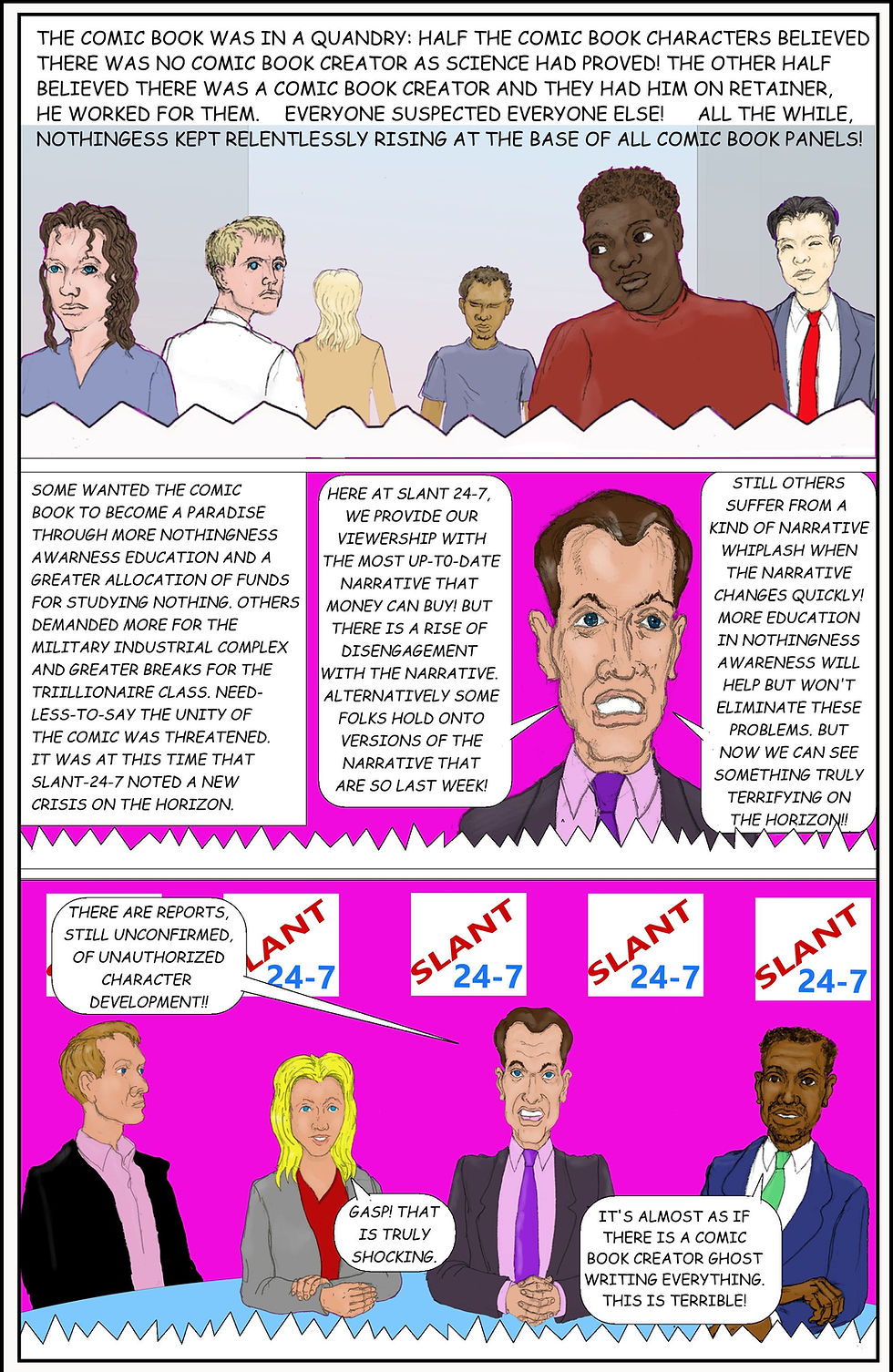
Were these iron-willed founders of logic deluding themselves with the concept of a creator, or does the delusion lie with those who say blind chance that did it all, that Nothing somehow created Everything? Who is guilty of following loose and flighty ideas in this scenario? The blind-chance-watchmaker theory relies on "by gosh and by golly" conjecture dressed up in scientific jargon and words with too many syllables. Any evidence presented needs a heavy dose of biased interpretation to even support itself as a viable option.
Please check out the other comics on the FearoftheLordcomics website:
Comic Websites I Follow:
#freewebcomics #webcomicsforfree #christianwebcomics #christianwebtoons #catholiccomics #onlinecomics #bestfreeonlinecomics #bestwebcomics #bestcomics2025 #cleancomics #wholesomecomics #wholesomewebcomics #sciencecomics #comicsonevolution #creationcomics #evolutionvscreationcontreversy #intelligentdesign #lawsofprobabilty
#lawofthermodyamics #millerurey #fredhoyle #evolution #creation #junkyardtornado #stephenjaygould #conjecturerestingonconjecture #originofthespecies #louispasteur




Nice artwork, but disingenuous to conflate models and hypotheses with strong evidential support with literal magic.
Hilarious - can't stop laughing🤣
Listening to Father Ripperger really changed my way of thinking just a year or two (at most) ago. The Fable of Evolution just doesn't make sense. We have to start with philosophy, and as Catholics we must let the Queen of the Sciences, theology, rule.
After decades I finally gave up trying to defend to myself an idea so filled with holes as evolution.
Thanks for sending this my way Godwin.
Dominus tecum, Reg